News
Powder Coating vs. Wet Paint: Which Finish Is Right for Sheet Metal Parts?
September 23, 2026
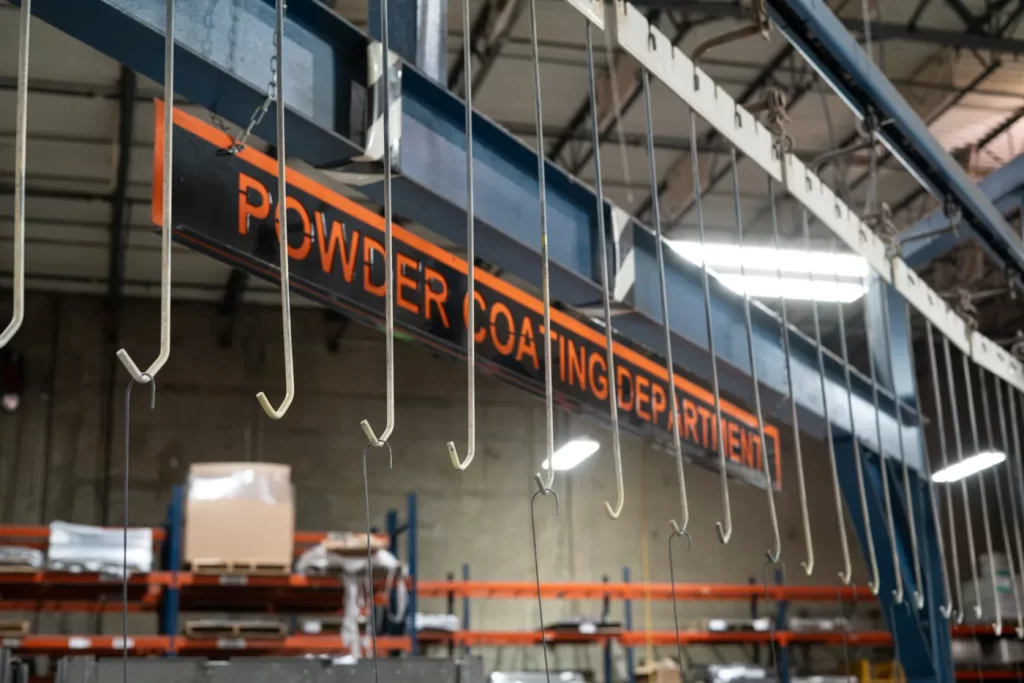
The finish is the last thing applied to a sheet metal part and usually the first thing a customer notices. It is also the specification most often decided late, decided casually, or copied forward from a legacy drawing nobody has revisited in a decade. That is a costly habit. The coating on an enclosure, bracket, or cabinet is not decoration. It is a functional layer that determines how the part survives salt, sunlight, solvents, vibration, and handling. It also drives fit, assembly sequence, lead time, and unit cost.
For most precision sheet metal work, the decision comes down to two options: powder coating or wet paint. Both can produce an attractive, durable, color-matched surface. They fail in different ways, cost money in different places, and impose different constraints on the design. Choosing well means understanding those differences before the part is released to production — not after the first article shows up with paint bridging a threaded hole.
The short answer
For the majority of production sheet metal — enclosures, cabinets, chassis, panels, brackets, weldments, racks, and guarding — powder coating is the default and the better answer. It delivers a harder, thicker, more chip-resistant film in a single application, cures in minutes rather than hours, produces almost no volatile organic compound (VOC) emissions, and reclaims its own overspray. On an automated line it is also the cheaper process per part at volume. Wet paint earns its place in a narrower set of cases, covered further down.
| Criterion | Powder coating | Wet paint |
|---|---|---|
| Durability | Harder, thicker single-pass film; better chip and abrasion resistance | Softer film; competitive only as an engineered multi-coat system |
| Film thickness | About 2 to 3 mils per surface; hard to go thinner | About 1 mil per coat, controlled finely |
| Cost at volume | Lower per part on an automated line; higher fixed cost | Lower fixed cost; wins on low volume and one-offs |
| Color and gloss | Any gloss or texture in standard shades; custom colors are batched | Mixed on demand to any shade; easier smooth, high-gloss finishes |
| VOC and waste | No solvents, essentially no VOCs, overspray reclaimable | Solvent evaporation inherent; overspray lost; waste stream needs handling |
| Field repair | Cannot be re-cured in place; liquid touch-up is a compromise | Sanded, feathered and touched up on site |
How each process actually works
Powder coating
Powder coating is a dry process. Finely ground thermoset polymer — usually polyester, polyurethane, epoxy, or a polyester-epoxy hybrid — is given an electrostatic charge and sprayed at a grounded metal part. The charge holds the powder to the surface, including around edges and into moderate recesses, before any curing happens. The part then travels through an oven where the powder melts, flows out, and cross-links into a continuous, chemically bonded film. Typical cure schedules run 350 to 400 degrees Fahrenheit for ten to twenty minutes, depending on chemistry and part mass. Ultraviolet-cured powders are also available for parts that cannot tolerate a full thermal bake.
Everything upstream of the spray booth matters as much as the powder itself. Pre-treatment — the cleaning, etching, and rinse stages that strip oils, oxides, weld smut, and forming lubricants and lay down a conversion coating — determines whether the finish stays attached in year seven. A premium powder over a poorly cleaned panel will fail faster than an economy powder over a properly prepared one. Pre-treatment is the most commonly underestimated line item in a finish specification, and it is invisible on the finished part.
Wet paint
Wet paint suspends pigment and resin in a liquid carrier — solvent-borne or water-borne — and delivers it by spray gun, occasionally by dip or flow coat. The carrier evaporates, and the film dries or cross-links at ambient temperature or under low heat in a force-dry booth. Industrial systems are typically layered: a primer for adhesion and corrosion resistance, then one or more topcoats for color and gloss, sometimes with a clear over the top.
That layering is both the advantage and the cost. Each coat needs flash time before the next, so a wet-painted part occupies floor space and work-in-process time in a way a powder-coated part does not. It also means the process can be tuned coat by coat — a zinc-rich primer under a marine topcoat, or a thin film where a thick one would cause interference.
The six criteria that decide it
1. Durability and corrosion resistance
Powder wins on mechanical toughness, and it is not close. The cross-linked thermoset film is harder and more resistant to chipping, scratching, and abrasion than a comparable liquid film, and it is applied thicker in a single pass. On parts that get handled, stacked, shipped, installed by a crew in the field, and then live outdoors, that difference shows up as fewer warranty calls.
Corrosion resistance, though, is a system property rather than a coating property. Salt spray performance per ASTM B117 depends on substrate, pre-treatment chemistry, film build, and edge coverage as much as on the powder or paint selected. Polyester powder over properly pre-treated steel is routinely specified from a few hundred B117 hours for general industrial service to a thousand hours and beyond for demanding environments. Wet systems can be engineered to hit those numbers too, particularly with a zinc-rich primer, but generally need more coats to get there.
Ultraviolet stability is a chemistry question in both camps. Epoxy powders offer outstanding chemical and corrosion resistance but chalk and fade in sunlight, which makes them an interior-only choice. Polyester and polyester-urethane powders are the outdoor workhorses. Specifying “powder coat, black” without naming a resin family is how an outdoor enclosure ends up chalked and faded long before its service life is up.
2. Film thickness and dimensional tolerance
This is where sheet metal parts get into trouble, and it deserves more attention than it usually gets.
A standard powder film runs roughly 2 to 3 mils, about 50 to 80 microns, and most product data sheets specify a target inside that band. Wet paint can be laid down considerably thinner — on the order of 1 mil per coat — and controlled more finely coat to coat.
Two or three mils sounds trivial until you multiply it. Coat both faces of a panel and you have added up to 6 mils to the stack; coat both mating flanges of a bolted joint and you have added the same again. Put that film inside a clearance hole, on a slip-fit boss, on the register of a door that closes on a gasket, or on the pilot diameter of a bearing pocket, and a nominally in-tolerance part will not assemble. Powder also builds heavily on outside corners and pulls away from inside corners, so the buildup is not uniform.
The fix is not to abandon powder — it is to design for it. Open up clearance holes, call out masking on critical surfaces, dimension features as post-coat where it matters, and tell your fabricator which surfaces are functional rather than cosmetic. When a component genuinely cannot accept a thick film and cannot be masked, that is a legitimate reason to look at wet paint.
3. Cost and throughput
Powder has higher fixed costs — booths, ovens, conveyance, reclaim systems, pre-treatment chemistry management — and lower variable costs. Wet paint is the reverse. So the honest answer to “which is cheaper?” is that it depends on volume, and on who owns the equipment.
For repeat production at a fabricator with an existing automated line, powder is almost always the lower cost per part, and the reasons compound. One application, one cure — no primer, no flash time, no second topcoat. High electrostatic transfer efficiency, with unstuck overspray collected and reused rather than becoming hazardous waste; wet overspray is simply gone. Cure measured in minutes, so a conveyorized line runs parts continuously through pre-treatment, dry-off, coating, cure, and inspection without staging racks of drying parts. And fewer touch-ups, refinishes, and field failures over the life of the product.
Wet paint becomes cost-competitive on low volumes, on one-off and prototype work, on parts too large to justify oven capacity, and on jobs where a custom color would otherwise trigger a powder minimum order quantity.
4. Color, gloss, and texture
Modern powder is not the limited palette it was twenty years ago. Smooth, textured, hammered, matte, satin, and high-gloss finishes are all standard, and effects like wrinkle, veined, and coarse textures that hide substrate imperfection are readily available. Powder also holds color well over time, provided the resin family matches the service environment.
Wet paint keeps two advantages. First, it can be mixed on demand to virtually any custom shade, which matters when you need to match an existing assembly, a legacy part, or a brand standard that predates your current supplier. Powder custom colors are manufactured in batches, which means minimum quantities and lead time. Second, powder struggles to produce very thin, perfectly smooth films — orange peel is the usual result — so Class-A cosmetic surfaces still tend to go wet.
Multi-color parts are the classic powder headache: a second color means masking, and masking that has to survive a cure oven adds cost and risk. Silk-screening after coating is often the cleaner way to add graphics, legends, and branding without a second color cycle.
5. Environmental and regulatory profile
Powder coating uses no solvents and generates little or no hazardous waste. The EPA notes that powder coatings emit virtually no VOCs and are generally the lowest polluting of all coatings, which simplifies air permitting, reduces the need for emissions control equipment, and keeps a shop’s compliance burden lighter. Overspray reclaim cuts material waste further. The trade-off is oven energy.
Wet formulations have improved substantially, and water-borne systems reduce VOC load considerably, but solvent evaporation is inherent to the process. Facilities running wet lines typically need additional ventilation, capture, and emissions management, and the waste stream requires handling. For OEMs with corporate sustainability reporting obligations, that difference increasingly shows up in supplier scorecards, not just in permits.
6. Repair and rework
This is wet paint’s clearest structural advantage. A liquid finish can be sanded, feathered, and touched up with a matching paint pen or spray can — on the shop floor, at the loading dock, or in the field after installation. A powder finish cannot be re-cured in place. You cannot put an installed switchgear cabinet back through an oven. Damaged powder is either touched up with a color-matched liquid paint, which restores appearance better than it restores performance, stripped and recoated, or left alone.
If your product is a large structure that gets scratched during installation as a matter of routine, build a field touch-up plan into the specification from the start, whichever finish you choose.
When wet paint is the right answer
Wet paint is the right engineering call when any of the following is true.
| When this is true | Why powder cannot do it |
|---|---|
| The part cannot take the heat | Cure temperatures around 400 degrees Fahrenheit will deform or destroy plastics, nylon-insert hardware, rubber seals, wiring, gaskets, bearings, and electronics. Pre-assembled units containing any of these must be coated before assembly, masked, or wet painted. |
| The part will not fit the oven | Very large weldments and long frames may exceed the line’s opening or hanging capacity. |
| The film has to be thin | Close-fitting mating components and precision features sometimes cannot tolerate a 2 to 3 mil build, and masking is impractical. |
| The color has to be matched exactly, right now, in a small quantity | Custom powder is manufactured in batches, which means a minimum quantity and a lead time. |
| The part is multi-color | A second color means masking, and masking that has to survive a cure oven adds cost and risk. |
| Deep internal cavities need coverage | The same electrostatic attraction that gives powder good edge coverage works against it in deep recesses and Faraday-cage geometry. |
| The finish must be repairable in the field | A powder finish cannot be re-cured in place, so a long service life with routine damage favors liquid. |
If none of those describe your part — and for most production sheet metal none of them do — powder is the answer.
Design for finish: what to get right before release
Most finishing problems are actually design and sequencing problems. A short checklist.
| Design point | What to do, and why |
|---|---|
| Sequence hardware correctly | Nylon-insert nuts lose their locking function at oven temperature, and plastic bushings and heat-sensitive inserts will not survive the bake. They install after coating. Your fabricator should catch this in a design-for-manufacturability review, but the sequence is easier to plan than to fix. |
| Call out masking explicitly | Threaded holes, ground studs, weld-prep areas, gasket lands, bearing bores, and electrical bonding surfaces all need to be identified. Precision masking is a standard service; unrequested masking is not. |
| Preserve ground paths | Coating is an insulator. Every enclosure needs at least one deliberately masked, coating-free bonding point. |
| Plan hanging points | Parts hang from hooks on a conveyor, and the contact point does not get coated. Give the coater a non-cosmetic location, or expect rack marks somewhere you would rather not have them. |
| Add drain and vent holes | Enclosed volumes trap pre-treatment solution, which then boils out in the oven and ruins the finish. |
| Clean up the substrate | Weld spatter, deep scratches, sharp burrs, and heavy mill scale telegraph straight through the film. Powder is a coating, not a filler. If the part is cosmetic, specify the surface condition before coating. |
| Match pre-treatment to the substrate | Steel, aluminum, and stainless each want a different chemistry for adhesion. Mixed-material assemblies need a plan. |
How to specify the finish on the drawing
“Powder coat black” is not a specification. It is a hope. A useful finish callout names the following.
| Call out | What to specify | Reference |
|---|---|---|
| Resin family | Polyester, polyester-urethane, epoxy or hybrid, and whether service is interior or exterior | AAMA 2603 / 2604 / 2605 durability class |
| Color | A standard reference such as a RAL number, plus manufacturer and product code if established | RAL, with ASTM D2244 for color-difference tolerance |
| Gloss | Gloss level and measurement geometry | ASTM D523, typically at 60 degrees |
| Film thickness | Target range in mils, and anywhere a maximum applies | ASTM D7091 |
| Adhesion | Cross-hatch adhesion requirement | ASTM D3359 |
| Impact and hardness | Where relevant to the application | ASTM D2794, ASTM D3363 |
| Corrosion | Requirement in salt spray hours, if any | ASTM B117 |
| Masking | Masked areas, on the drawing rather than in an email | No industry standard — flag it on the drawing |
| Cosmetic surfaces | Which surfaces are cosmetic, and acceptance criteria for each | No industry standard — use your fabricator’s cosmetic classes |
| Packaging | How it ships — a perfect finish damaged in a rack is still a reject | ASTM D3951 |
Ten minutes spent on this at design release prevents most first-article disputes.
Powder coating at SPM
Special Products & Mfg., Inc. has been coating customers’ parts since 1984 — in-house powder coating inside a company with 62-plus years of precision sheet metal fabrication behind it. The finishing operation is built for exactly the kind of repeat OEM production this article is about.
The line at our Rockwall, Texas headquarters is a 1,500-foot fully automated conveyer system, capable of running as lights-out manufacturing. Parts move continuously through a six-stage pre-treatment system — the cleaning, etching, and rinse cycles that decide whether a finish lasts. From there they pass through separate dry-off and curing ovens. Maximum part opening on the line is 42 by 54 by 108 inches. Automated booths with robotics handle high-volume production; manual booths take on the large, small, and odd-shaped jobs a standardized line cannot absorb.
Curing is available by heat or by ultraviolet light, which gives thermally sensitive parts a path a conventional bake cannot offer. We coat steel, aluminum, and stainless, pre-treated for adhesion, in smooth, textured, hammered, matte, and gloss finishes with custom colors on request. Precision masking and material prep happen before coating, silk-screening is available downstream for legends and branding, and quality control, light assembly, and packaging come straight off the line.
The case for finishing where the part is made
There is a second decision hiding behind powder-versus-paint: who does the coating, and where.
When fabrication happens in one building and finishing happens in another company’s building across town, every part takes an extra round trip — racked, trucked, unracked, and handled by people who did not make it. Dings happen. Lead time stretches. And when something goes wrong, accountability splits: the coater blames the substrate, the fabricator blames the pre-treatment, and the customer waits.
SPM runs fabrication, machining, welding, powder coating, and electro-mechanical assembly under one roof, across three Texas facilities totaling 182,000 square feet and more than 200 team members. A laser-cut, formed, and welded enclosure moves from the weld cell to pre-treatment without leaving the building, gets coated, gets assembled, and ships as a finished unit. One supplier, one quality system, one point of accountability — backed by ISO 9001 certification, an ERP system driving traceability since 2015, and recognition as The Fabricator’s 2025 Fabricator of the Year.
Our engineering team also supports the front end of this decision. Through NPI and DFM support, and customer education through SPM University, we work through masking strategy, hardware sequencing, tolerance implications, and finish specification. That happens while the design is still changeable, which is the only time changes are cheap.
Frequently asked questions
Is powder coating always more durable than wet paint?
Film for film, powder is harder and more resistant to chipping and abrasion because of the thermal cross-linking it undergoes during cure and the thicker build it is applied at. But durability in service is a system outcome. A correctly engineered multi-coat wet system over excellent pre-treatment will outperform a powder finish applied over a dirty substrate. Preparation, chemistry selection, film build, and complete cure decide the outcome.
How much thickness does powder coating add to a part?
About 2 to 3 mils, roughly 50 to 80 microns, per coated surface, with additional buildup on outside corners. Account for it on both faces of a panel and both halves of a mating joint, and mask features where the added film would interfere.
Can powder coating be touched up in the field?
Not with powder — re-curing requires an oven. Damaged areas are touched up with a color-matched liquid paint, which restores appearance better than performance. For parts that will inevitably be scratched during installation, plan a touch-up procedure in advance.
What if my assembly contains plastic or electronics?
Coat the metal components before assembly, mask the sensitive areas, or use a UV-cured powder where a full thermal bake is not viable. SPM offers ultraviolet curing specifically for thermally sensitive parts. Sequencing the assembly after coating is often the simplest answer.
Which is cheaper?
At repeat production volume through an automated in-house line, powder is generally less expensive per part: one application, one cure, high transfer efficiency, reclaimable overspray. Wet paint tends to win on very low volumes, one-off custom colors, and parts that cannot go through an oven.
Can powder coating match a specific color?
Yes. Provide the RAL number or, better, the exact powder manufacturer and product code you want matched. Established colors are straightforward. Genuinely custom shades are manufactured in batches, which means a minimum quantity and a lead time — worth planning around early.
What is the largest part SPM can powder coat?
Maximum part opening on the automated line is 42 by 54 by 108 inches. Alongside the automated line, SPM runs manual booths that take on large, small, and odd-shaped jobs a standardized line cannot absorb. Send us the geometry and quantity and we will tell you how it routes.
Get the finish decision right the first time
The best time to settle powder versus wet paint is before the part is fabricated, when prep, chemistry, color, masking, and assembly sequence can all be specified together. The most expensive time is after the first article ships.
Send us your drawings and your service environment. Our team will walk through the finish specification with you, flag the hardware and tolerance issues before they become rework, and quote the part complete — cut, formed, welded, coated, assembled, and packaged.
Have a project to quote?
Send us your specs. We’ll respond within one business day.