News
Electro-Mechanical Assembly vs. Separate Fab and Assembly Vendors
September 23, 2026
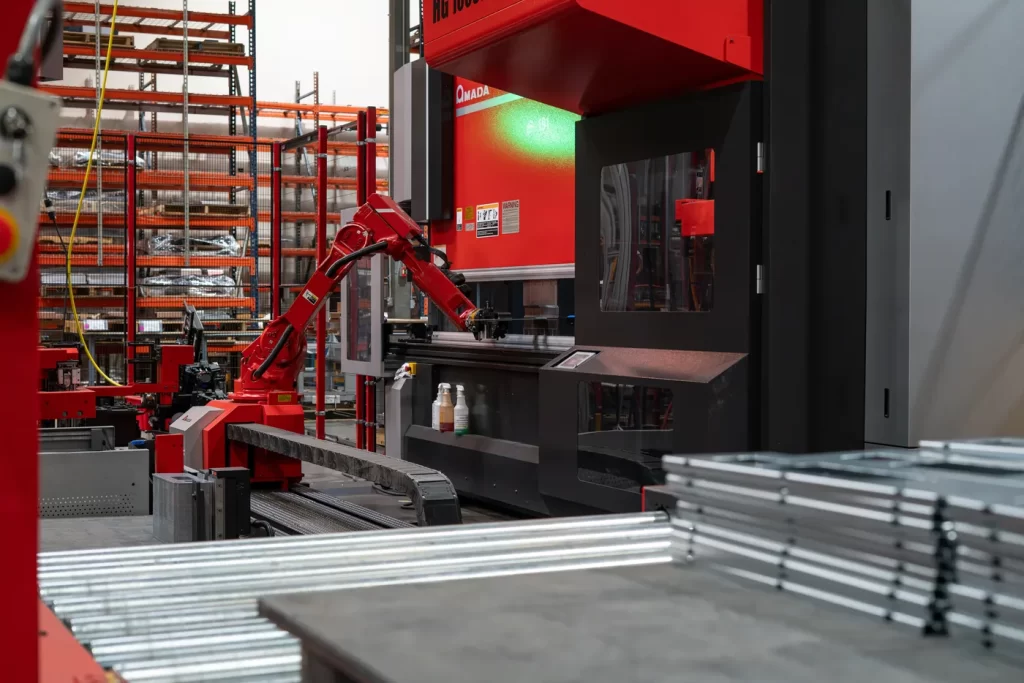
Two sourcing models sit behind every enclosure, cabinet, and control panel an OEM ships. One consolidates fabrication, finishing, and assembly under a single roof and a single quality system. The other splits the build across a fab shop, a finisher, and an assembly house, then asks a buyer to stitch the schedule back together. The quoted piece price rarely tells you which one costs less.
The sourcing decision most quotes never show you
An engineering buyer sourcing a populated NEMA enclosure has two structurally different paths. In the first, a single contract manufacturer does all of it. That shop cuts the sheet metal, forms and welds it, coats it, populates it with passive devices, torques the hardware, tests it, and crates it for shipment. In the second, that same enclosure passes through three or four companies before it becomes a finished good. A fab shop cuts the metal. An outside coater applies the finish. An assembly house handles population and wiring. Sometimes a fourth vendor handles testing or packaging.
Both paths produce an enclosure. Neither produces the same program cost, lead time, or accountability structure. The fragmented path distributes cost across several purchase orders, several freight legs, and a considerable amount of unbilled internal engineering time. That is why it frequently looks cheaper on paper while running more expensively in practice.
What electro-mechanical assembly actually means
Electro-mechanical assembly is the integration of electrical and mechanical components into a single finished or near-finished product. You will also see it called box build, systems integration, or higher-level assembly. The terms overlap heavily, and the industry uses them somewhat interchangeably.
In practice, an electro-mechanical assembly starts with a fabricated structure: an enclosure, cabinet, frame, chassis, or panel. That structure is then populated with the components that make it functional. Depending on the program, that can include:
- Passive devices installed directly into panels and enclosures
- Cables, fans, and switches
- Door handles, cam locks, and chassis slides
- Hinged doors and door mechanisms
- Gasketing, EMI/RFI shielding, and seal gasketing
- Wire splicing and soldered connections
- Torqued mechanical fasteners with recorded values
The finished assembly is then inspected, tested where the specification requires it, packaged, and shipped. At SPM, that work runs on a dedicated mixed-model moving line with an Andon system. It is supported by digitized work instructions and a Quality Control department that reviews assembled product before it leaves the floor.
The distinguishing characteristic is not the presence of electrical components. It is that one organization owns the transition from raw material to functional product. That includes the point where mechanical tolerances and electrical fit have to agree with each other.
What the separate-vendor model looks like on the floor
The multi-vendor model is the historical default, and it exists for understandable reasons. Job shops specialize. A laser and press brake operation is a different business than a wiring and population operation, and for decades OEMs built their supply base out of specialists.
A typical fragmented flow for a control cabinet looks something like this:
- Buyer issues PO #1 to a fab shop for the cut, formed, and welded enclosure
- Fab shop completes parts, then ships to a coater, or ships back to the OEM, who ships to the coater
- Buyer issues PO #2 to the powder coat or paint vendor
- Coated parts ship to the assembly house
- Buyer issues PO #3 to the assembly house, plus separate POs for purchased components
- Assembly house populates, wires, and tests
- Finished units ship, either to the OEM, to a packaging vendor, or direct to the end customer
Every arrow in that sequence is an interface. Each interface carries freight, a receiving transaction, an incoming inspection, and a window of work-in-process inventory. Each one is also an opportunity for the schedule to slip. None of that appears on a piece-price comparison.
Where the handoffs cost you
Tolerances that pass at one shop fail at the next
This is the failure mode that costs the most and gets discussed the least. A fabricator produces parts to a drawing and inspects to that drawing. The parts pass. The assembly house then finds that a hole pattern, a formed flange, or a door opening will not take the hardware once real components are installed and stack-up accumulates.
Nobody is technically at fault. The fab shop met print. The assembly house met its work instructions. The tolerance stack was simply never validated against a real assembly by anyone who could see both sides. The result is rework, a drawing revision, a schedule slip, and a conversation in which two suppliers each explain, accurately, that the problem started with the other one.
When fabrication and assembly share a floor, that loop closes in hours instead of weeks. The assembly team’s fit problem is the fab department’s fit problem, and both report to the same quality system.
Lead times stack instead of overlapping
In a fragmented chain, each vendor quotes its own lead time and builds in its own buffer. Those numbers add rather than average, and the buffers add on top. A four-week fab lead time, a one-week coating window, a three-week assembly lead time, and freight between each does not resolve to four weeks of exposure. It resolves to eight or nine, plus whatever cushion each supplier holds back to protect its own on-time metric.
Delay also propagates. A one-week slip at the fab shop does not push the program out one week. It can cost the assembly house its scheduled production window entirely, which pushes the program out by however long it takes to get back into that queue.
Freight, double handling, and WIP you are financing
Parts that move between facilities are parts you pay to move, package for transit, unpack, and inspect again. Sheet metal enclosures are bulky and easily damaged in transit. Cosmetic parts are especially exposed: a scuff picked up on a trailer between the coater and the assembly house becomes a scrap or rework decision at the next stop.
Then there is carrying cost. Every buffer between vendors is capital sitting in a partially finished state, insured, stored, and not yet billable to your customer.
Incoming inspection performed three times
Each vendor inspects what arrives and what it ships. That is appropriate, and it is how a quality system works. But across a fragmented chain the same features get measured repeatedly, and your own organization often adds a receiving inspection before releasing parts to the next vendor. Consolidation removes the duplicated checks without removing the control, because the parts never leave a single documented quality system.
Revision control drift
An ECO issued mid-program has to reach every vendor, be acknowledged by every vendor, and be reflected in every vendor’s routing, tooling, and inspection documentation. Miss one and you build a partial lot to the old revision. The more suppliers hold your drawing package, the more places a stale revision can hide.
Under a consolidated model, one team updates routing, work instructions, and inspection points together. The ERP system carrying the program then pushes the change across every downstream operation at once.
The accountability gap
When a finished assembly fails, someone has to own the corrective action. In a multi-vendor program, the first thing that happens is an argument about where the defect originated. While that argument runs, nothing is fixed and nothing ships. Single-point accountability does not make defects disappear. It removes the interval between finding one and having a team assigned to it.
Administrative overhead nobody budgets
Three vendors means three quote cycles, three POs, and three sets of invoices. It also means three supplier qualifications, three audit cycles, three sets of certificates to collect, and three relationships to manage. Most of that labor belongs to buyers and engineers whose time is charged to overhead rather than to the program. That is exactly why it never shows up in a cost comparison, and exactly why it is real money.
Piece price versus total cost of ownership
A specialized job shop with low overhead will often quote a lower unit price. An integrated manufacturer carries assembly bays, a powder coat line, an engineering department, and inventory warehousing. That is not a pricing anomaly. It reflects a genuinely narrower cost structure.
The comparison only becomes meaningful when it covers the full program. A defensible total-cost-of-ownership comparison includes:
| Cost element | Multi-vendor | Consolidated |
|---|---|---|
| Piece price | Often lowest per operation | Quoted at assembly level |
| Inter-facility freight | Multiple legs per unit | Internal transfer |
| Transit packaging & handling | Repeated at each stop | Once, at ship |
| Incoming inspection labor | Duplicated across vendors | Single quality system |
| Buyer coordination time | Multiple POs, expedites, follow-up | One PO, one contact |
| Engineering time on interfaces | Fit disputes, stack-up resolution | Resolved in-house |
| WIP inventory carry | Buffer at each handoff | Reduced staging |
| Rework & scrap from handoffs | Transit damage, fit failures | Lower exposure |
| Schedule risk / expedite fees | Cumulative and propagating | Single schedule |
Run that comparison honestly and the integrated model frequently wins even when it loses on unit price. Run only the unit-price comparison and it will lose every time. That is precisely why the fragmented model persists in organizations that measure procurement performance on purchase price variance.
When separate vendors are still the right answer
Consolidation is not universally correct, and any manufacturer telling you otherwise is selling rather than advising. The multi-vendor model remains the better structure in several real situations.
Your program requires a certification your partner does not hold
SPM is ISO 9001 certified company-wide and does not currently hold AS9100D, NADCAP, ITAR registration, ISO 13485, IATF 16949, or ANSI/ESD S20.20. For flight-critical aerospace work, FDA Class II or III devices, safety-critical automotive components, or fully ESD-controlled assembly environments, the right answer is a manufacturer certified to that scope. SPM will scope its work to the non-controlled portion of your bill of materials and partner-refer the rest rather than take work outside its certified boundary.
You need a genuinely niche process
Specialty plating, unusual coatings, or a proprietary process that no integrated shop runs in-house will require an outside specialist regardless of how the rest of the program is sourced.
You are deliberately dual-sourcing for continuity
Concentrating a program with one supplier creates dependency, and dependency is a real risk if that partner hits a capacity ceiling, a quality system failure, or financial trouble. Many mature programs consolidate the bulk of the work and maintain a qualified secondary source specifically to manage that exposure. That is sound risk management, not indecision.
Volume or complexity does not justify it
A simple, mature, high-volume commodity bracket with a stable drawing and no assembly content does not need an integrated partner. It needs the most efficient shop that can make that bracket.
The useful question is not “consolidated or fragmented.” It is “which portions of this program actually benefit from being under one roof, and which do not.”
Scoping your program: the SPM Complexity Model
One reason these sourcing conversations go sideways is that “assembly” describes wildly different scopes. A bracket with two PEM inserts and a fully populated, tested, and crated cabinet are both technically assemblies. They should not be quoted the same way or sourced the same way.
SPM uses a five-level Complexity Model to make that explicit before quoting:
| Level | Name | Defining scope |
|---|---|---|
| Level 1 | Mechanical Components | Single-piece parts, standard materials, PEM hardware, welding, and finishes up to Class B paint and plating |
| Level 2 | Cosmetics | Class A and A+ finish requirements, anodize plating, grained and PVC-coated material, silk screening, specialized packaging. External doors, covers, control panels, hoods, faceplates, chassis fronts, and instrument panels typically live here |
| Level 3 | Mechanical Assembly | Assembly required, fixtures, purchased items, up to ten parts and 25 BOM items, multi-piece welding, fasteners, and gaskets |
| Level 4 | Complex Mechanical Assembly | Level 3 plus specialty items, more than ten parts, 25 to 100 BOM items, tubing and angle, inventory management, and specialized packaging |
| Level 5 | Electro-Mechanical Assembly | Level 4 plus higher part counts, passive components, testing, logistics, inventory management, and specialized packaging |
The model is useful independent of who you buy from. Programs at Levels 1 and 2 are usually well served by component sourcing, integrated or not. The consolidation argument gets strong at Level 3. It becomes hard to argue against at Levels 4 and 5. At those levels, part counts, BOM depth, purchased components, testing, and logistics compound the coordination burden all at once.
Locate your program on that ladder before you request quotes and you will get comparable quotes back. Skip that step and you will get a fabrication quote from one supplier and an assembly quote from another, with no reliable way to compare them.
What SPM keeps in-house
SPM’s argument for consolidation rests on which operations actually happen under its own roof rather than being subcontracted out behind a single invoice. At the Rockwall headquarters, the full capability line runs in one 145,000-square-foot facility:
- Precision sheet metal fabrication: punching, laser cutting, and forming, with lights-out automation capability
- CNC machining for precision components that have to align with fabricated structures
- Welding: MIG, TIG, robotic, spot, and stud welding, with AWS D1.3 sheet steel certification
- Powder coating and in-house painting, including Class A+ cosmetic finishes
- Electro-mechanical assembly, including hinge and door mechanisms, riveting, adhesive bonding, kitting, hardware insertion, and sub-assembly prestaging
- NEMA enclosure builds in NEMA 1, 3R, 4, 4X, and 12 ratings, with UL listing supported per project
- Wire splicing and soldering by IPC-A-610-trained technicians
- HI Pot testing and torque measurement, with click, beam, digital, and slip-type torque tooling
- Custom packaging, skidding, and crating directly off the assembly line
Because coating happens between fabrication and assembly in the same building, cosmetic parts are never loaded onto a trailer in a finished state and handed to a third party. Torque values and HI Pot results are recorded inside one quality system. The traceability package that reaches your receiving dock covers the whole build, not one segment of it.
Standards the assembly work is built to
| Standard | Coverage | Notes |
|---|---|---|
| ISO 9001 | Quality management system | Certified company-wide; no uncertified production lines |
| AWS D1.3 | Sheet steel structural welding | Qualified welders and procedures |
| IPC-A-610 | Acceptability of electronic assemblies | Wire splicing and populated panel work |
| UL-listed enclosures | Custom UL-certified builds | Listing supported per project |
| NEMA ratings | NEMA 1, 3R, 4, 4X, 12 | Verified per project at quote |
The services that wrap the build
Consolidation delivers much of its value before the first part is cut. SPM’s value-added services cover the program lifecycle rather than the production window alone.
Design for Manufacturability
SPM planners and programmers review incoming parts for problem points and failure opportunities, then propose solutions. These are often changes that improve performance, shorten cycle time, or reduce cost. In a fragmented chain, nobody performs this review across the fab-to-assembly boundary, because nobody sees both sides of it.
New Product Introduction
SPM’s engineering team works through project mapping, prototyping, simulation, and execution. The goal is to move a customer product line onto its floor while reducing the capital investment the customer carries for production capability.
Rapid prototyping
The FasTrak system measures lead time in days, with typical projects moving from design to production in as little as one business week. An automated FTP recovery system checks for new files every half hour so prototype production can begin as soon as files land. The program is available to a selected group of customer accounts.
Inventory management
A 10,000-square-foot offsite warehouse, plus inventory space in Rockwall and Round Rock, supports KanBan, Just-In-Time, Built-to-Schedule, and Vendor-Managed Inventory programs. These can be based in SPM’s facility, the customer’s, or both. That directly addresses lead-time smoothing and obsolescence exposure, two costs the fragmented model tends to push back onto the OEM.
Customer education
Through SPM University, the team delivers on-site or virtual sessions covering Metal Fabrication 101, Design for Manufacturability, and Design for Cost Reduction & Quality. The sessions aim to help customer engineering teams design parts and assemblies that behave well in production.
Capacity behind the model
Consolidation only helps if the partner can absorb the work. SPM has operated since 1963 and runs three Texas facilities totaling 182,000 square feet with more than 200 team members:
| Facility | Size | Role |
|---|---|---|
| Rockwall headquarters | 145,000 sq ft | The full capability line, plus a nearby 10,000 sq ft offsite inventory warehouse |
| Fate | 10,000 sq ft | Full fab shop launched March 2026, minutes from the Rockwall campus |
| Round Rock | 27,000 sq ft | Opened 2020 to serve central Texas customers |
That capacity is measured, not asserted. SPM runs 99.6% on-time delivery, and was named 2025 Fabricator of the Year by The Fabricator.
Engineering buyers are welcome to tour the Rockwall operation. Walking the fab floor, the assembly bays, and the powder coat line in sequence tends to settle the consolidation question faster than any cost model does.
Questions worth asking any prospective partner
- Which operations do you perform in-house, and which do you subcontract? Ask specifically about coating and testing, the two most commonly outsourced behind an integrated-sounding quote.
- Will your engineering team review our drawings before we freeze them, and what does that review cover?
- What is your quoted lead time at the assembly level, not per operation?
- What certifications do you hold, and what do you not hold? A partner that answers the second half without prompting is telling you something useful.
- How is an ECO propagated through routing, work instructions, and inspection points?
- Who owns a corrective action on a finished assembly, and what is the response interval?
- Can you support prototype quantities and production volumes within the same quality system, without requalification?
- What inventory programs can you run, and where would the inventory physically sit?
Frequently asked questions
What is electro-mechanical assembly?
Electro-mechanical assembly is the integration of electrical and mechanical components into a finished or near-finished product. That usually means an enclosure, cabinet, chassis, or panel populated with devices, cables, switches, hardware, and wiring, then inspected, tested, and packaged. It is also called box build, systems integration, or higher-level assembly.
Is a single-source contract manufacturer always cheaper than separate vendors?
Not on piece price. An integrated manufacturer carries broader overhead than a specialized job shop and will often quote higher per operation. The advantage appears in total program cost, once freight, duplicated inspection, coordination labor, WIP carry, rework from handoffs, and schedule risk are included.
What is the biggest risk of using separate fab and assembly vendors?
Tolerance and fit failures found at assembly, on parts that passed inspection at the fabricator. Because both suppliers met their own documented requirements, resolution needs a design-level conversation neither vendor is positioned to lead. That is where programs lose weeks.
When does the multi-vendor model still make sense?
Three cases. When a program requires a certification or niche process the integrated partner does not hold. When an organization is deliberately dual-sourcing to manage concentration risk. Or when the part is a simple, mature commodity with no assembly content.
Does SPM populate panels with passive devices in-house?
Yes. SPM supports populating panel and enclosure assemblies with passive devices in-house, which removes the need to coordinate with a third-party assembly vendor for that step.
What certifications does SPM hold?
SPM is ISO 9001 certified company-wide, with AWS D1.3 certification in welding, IPC-A-610-trained wire splicing and soldering operations, and UL-supported NEMA enclosure production. SPM does not currently hold AS9100D, NADCAP, ITAR, ISO 13485, IATF 16949, or ANSI/ESD S20.20.
How should I scope my project before requesting a quote?
Locate it on the SPM Complexity Model. Levels 1 and 2 cover components and cosmetic parts. Levels 3 and 4 cover mechanical and complex mechanical assemblies. Level 5 covers full electro-mechanical assembly with passive components, testing, and logistics. Knowing your level produces comparable quotes.
Bring us your specs
Does your current program move parts between three buildings before it becomes a product? Then it is worth pricing the alternative properly. Quote it at the assembly level, against total program cost rather than unit price. Send SPM your drawings and we will respond within one business day.
Or call us at (972) 771-8851.
Have a project to quote?
Send us your specs. We’ll respond within one business day.